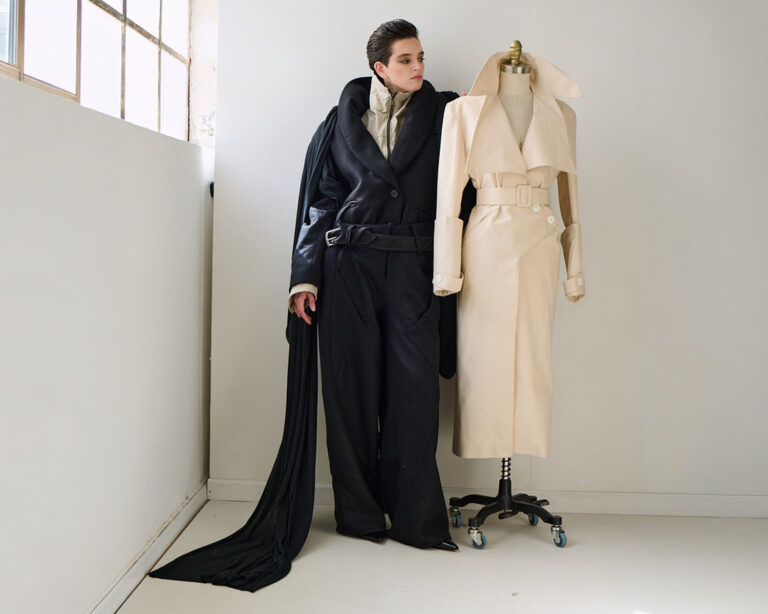


The collection that refuses to pretend fashion exists in a vacuum. Worn and Reborn examines the realities of fashion waste through Lagos-born designer Sharon Omowayeola. Using Aso oke and discarded textiles, she reconstructs garments that sit directly inside the environments that shaped them like markets, dumpsites, crowded streets, offering a grounded, necessary critique of consumption and the life cycle of clothing.
As I move through the photographs from Worn and Reborn, the first thing that strikes me is how direct they feel. Two models stand in busy Lagos spaces like such as markets, streets, and areas most fashion campaigns would avoid. The garments, made from structured Aso oke, hold their shape against the noise and movement behind them. Nothing about the images tries to soften the surroundings; instead, they sit comfortably inside them. The more I look, the clearer it becomes that this project isn’t chasing aesthetics alone. It is trying to explain something about the environment, culture, and the life cycle of clothing. The collection comes from Shaykara, the brand founded by designer Sharon Omowayeola, whose work sits at the intersection of sustainability, culture, and reconstruction.

The story of Worn and Reborn began long before the garments existed. “Worn and Reborn started from a place of frustration.”she says on the inspiration of the idea. “I grew up on the mainland in Lagos, and every day, on my way to Uni, I passed this massive dumpsite, and the stench was just unbearable.” Travelling across the mainland meant passing the Olusosun dumpsite (the largest in Africa) a place where mountains of waste sit inside one of the most densely populated cities on the continent.
This wasn’t an abstract environmental concern, it was a lived experience. A constant reality that revealed how waste quietly becomes part of everyday life. The experience left her aware of how little education existed around waste management, recycling, or the environmental cost of clothing.
Later, while working in fashion, she encountered the second layer of the problem, she shares her experience “Scraps in garment factories, damaged second-hand clothes arriving from western countries, and clothes being tossed aside frequently” Seeing both systems, municipal waste and fashion waste side by side created the foundation for Worn and Reborn. The project became a personal response to the gap between production and disposal. It was also an attempt to document how garments travel, who makes them, and how renewal might be possible within a waste-heavy industry.
This approach is clear in the choice of fabric. The project uses 100% cotton Aso oke, a textile that carries cultural weight within Yoruba communities. It is handwoven, durable, and traditionally passed down through generations. In a global context where sustainability is often presented as a new concept, Aso oke offers a reminder that African cultures have long practiced durability, care, and repair. She further explains her love for the fabric “Aso oke carries history, has survived generations, been passed down, repaired, cherished, and reinvented again and again. It is a reminder that our ancestors were echoing the essence of sustainability long before the word became popular. Choosing it was intentional. It represents who I am, where I come from, and the kind of future I want to build. One where culture and sustainability work hand in hand.”

Instead of using standard cutting layouts, the designer maps silhouette possibilities based on what the fabric remnants allow. “My creative process always begins with the material. I design with what already exists, whether that’s scrap fabric, deadstock, or natural fibres. Working this way forces me to think differently.” This method naturally produces more modular shapes, visible in the structured tops, skirt panels, and layered pieces seen in the garments.
Many of the looks appear simple at first glance, but the closer you examine them, the clearer the technical decisions become. Aso oke’s stiffness means every dart, seam, or fold shows. This requires precision. The garments rely on clean edges and intentional shaping. Instead of hiding the reconstructed nature of the garments, the designer highlights it, allowing the seams to become design elements, maybe even signatures.
The images in the shoot reflect this mindset. The clothing is photographed in spaces where waste is visible, not hidden. Lagos markets, dumpsites, and crowded streets form an honest backdrop. They highlight how easily fashion separates itself from the environments it affects, and how unusual it is to see fashion placed back into those environments with intention.
The design process itself follows a material-first approach. Instead of beginning with sketches and sourcing new fabric, the designer starts with what already exists – scraps, deadstock, or surplus Aso oke. Working this way requires flexibility. This system challenges traditional fashion workflows and removes the expectation of perfection. Using waste forces new ideas to emerge, and errors often evolve into design features rather than flaws. Experimentation becomes central.
Growing up in Lagos meant being surrounded by people who consistently found ways to create from limited resources. This resourcefulness is embedded in the designer’s approach to design. At the same time, living in London provided exposure to global conversations on sustainability, access to networks, and opportunities to refine craft through a broader lens. The combination of both environments Lagos and London results in work that is practical and culturally grounded. And informed by international sustainability standards without losing its authenticity.

Producing Worn and Reborn came with challenges that reveal the complexity of working in real environments. Securing access to Olusosun for filming required negotiation and patience. Shooting in markets meant navigating disruptions, crowds, and the unpredictability of public spaces. Even finding a garment factory willing to participate was unexpectedly difficult, partly due to misunderstandings about the project and hesitation around documenting production processes.
The project eventually reached international recognition when it was selected for the Official London Fashion Film Festival. This milestone allowed the film to enter conversations beyond its local environment and introduced global audiences to the realities of fashion waste in Nigeria. The screening also demonstrated how fashion can serve as a connector between cultures. It shows that environmental issues are shared responsibilities rather than isolated regional problems.
Beyond the collection and the film, Worn and Reborn forms part of a larger vision for the designer’s brand, Shaykara. The long-term goal is to build a platform that merges education, community engagement, and ethical production. Workshops, artisan collaboration, and transparent documentation of fashion waste are central to this vision.
Can fashion connect people and communities? Sharon says “When we repair clothes, share knowledge, or pass garments down, we build community and encourage collaboration between people and communities. I’ve seen this firsthand through the fashion workshops I’ve run. The sense of pride, accomplishment, belonging, and people bonding over creativity, upcycling, learning from each other, and celebrating their transformations.”
The guiding principle behind all of this is the idea of renewal.“ Renewal is a state of mind. Unlike change, which is constant, renewal is a decision.” She says on what renewal means to her. Renewal, in this context, is not an automatic cycle. It is an active decision to re-evaluate habits, reduce fashion waste, and design with awareness. It requires acknowledging how design choices affect communities, environments, and economies. Renewal also plays a role in the designer’s personal journey. It acts as a commitment to staying grounded, avoiding unnecessary guilt, and maintaining a mindset focused on continuous improvement.
Ultimately, Worn and Reborn raises the question we all (the fashion industry) have actively avoided and are struggling to answer. Do we need this many clothes in the world?
It’s a simple question, but one that challenges the entire system we’ve built. What Sharon proposes through her work isn’t groundbreaking, but it is deeply essential; it reflects a shift in mindset. If the next generation of designers is going to reshape this industry, this is the approach we need: designing great clothes with intention and necessity. Creating garments that earn their place in the world, rather than simply adding to the pile.