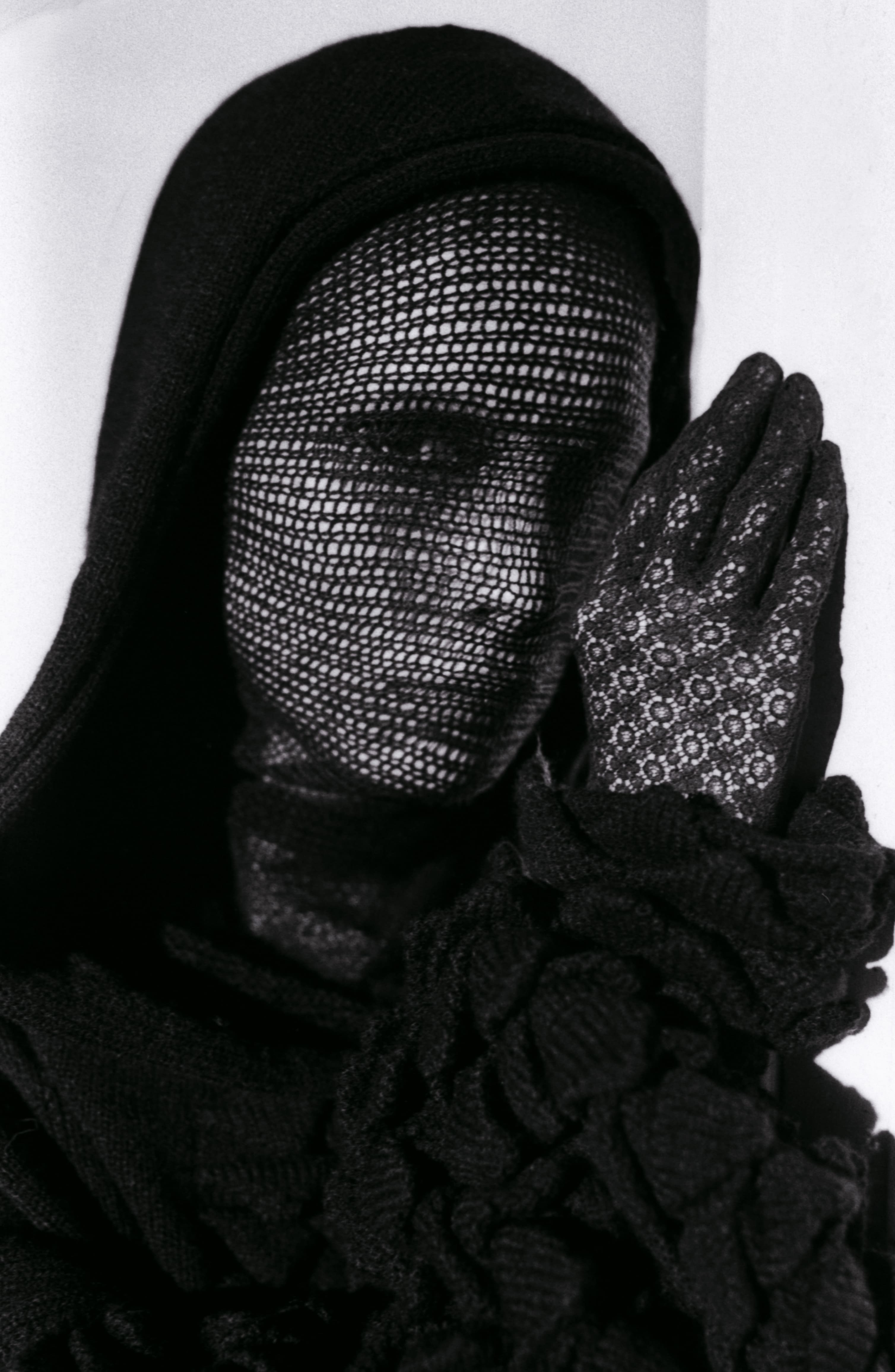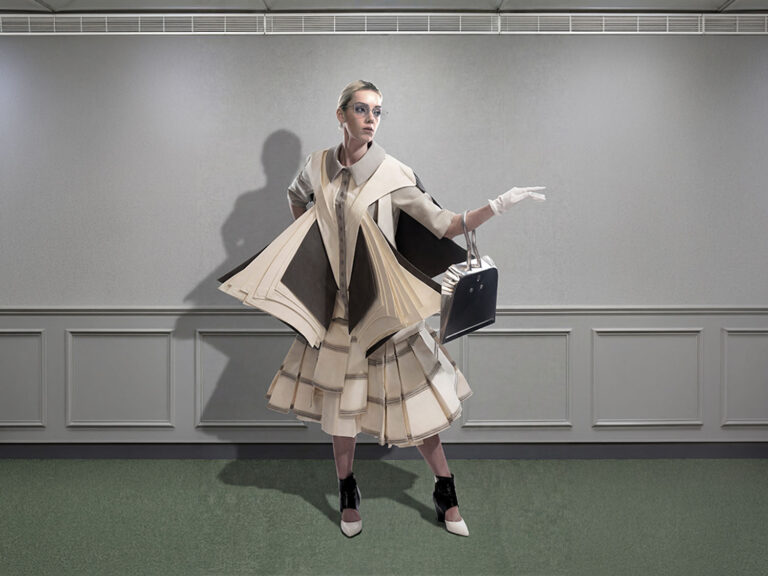

For Georgian designer Elisabed Amiredjibi, fashion serves a purpose beyond aesthetics. Through clothing, she preserves memory, documents political realities, and protects cultural identity. Her collection, Fight or Flight, emerged from a deeply personal struggle with distance, belonging, and the events unfolding in her homeland.
Developed at Parsons School of Design in New York, the collection explores Georgian youth culture through the visual language of protest. Graffiti-covered walls, political satire, traditional dress, literature, and performance traditions come together to tell a story about a nation facing uncertainty. At the same time, the work reflects the emotional reality of a young designer watching those events from thousands of miles away.
The idea for Fight or Flight grew from feelings of responsibility and frustration. While living in New York, Amiredjibi watched friends and family navigate the political tensions that continue to shape everyday life in Georgia. Although distance provided opportunities for her career, it also created a sense of guilt.
“Being away from home, and far from the political reality that my friends and family live in daily, I feel even more responsible to represent these issues,” she explains.
That responsibility became the driving force behind the collection. Rather than focusing solely on her own experience, Amiredjibi wanted to create something that reflected a broader community. She spoke with friends back home and gathered their perspectives on culture, identity, and representation. Their voices helped shape the project from the beginning.
“I didn’t want my perspective to be the only one,” she says. “After all, this was about my people, not about me.”
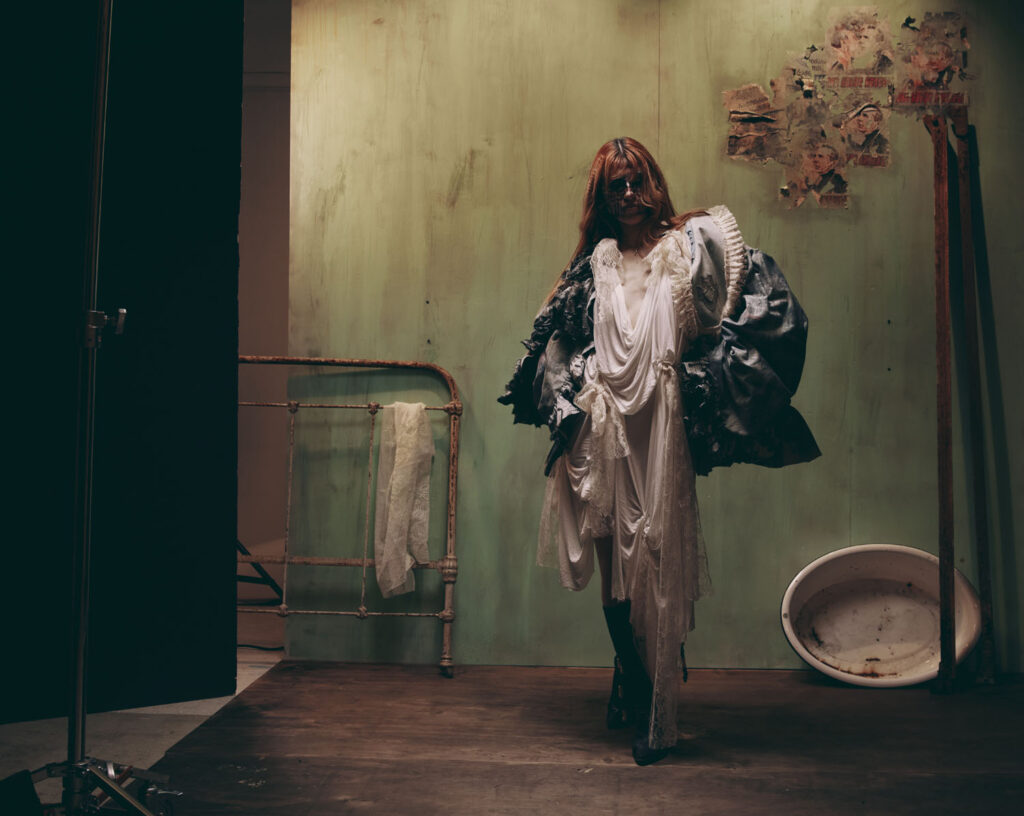
That collaborative spirit appears throughout the collection, particularly in the textiles. One of the project’s most distinctive elements is a series of fabric prints created from photographs of graffiti across Tbilisi. Friends documented the walls of the city and sent the images directly to Amiredjibi, who transformed them into wearable surfaces using Citrasolv oil transfers.
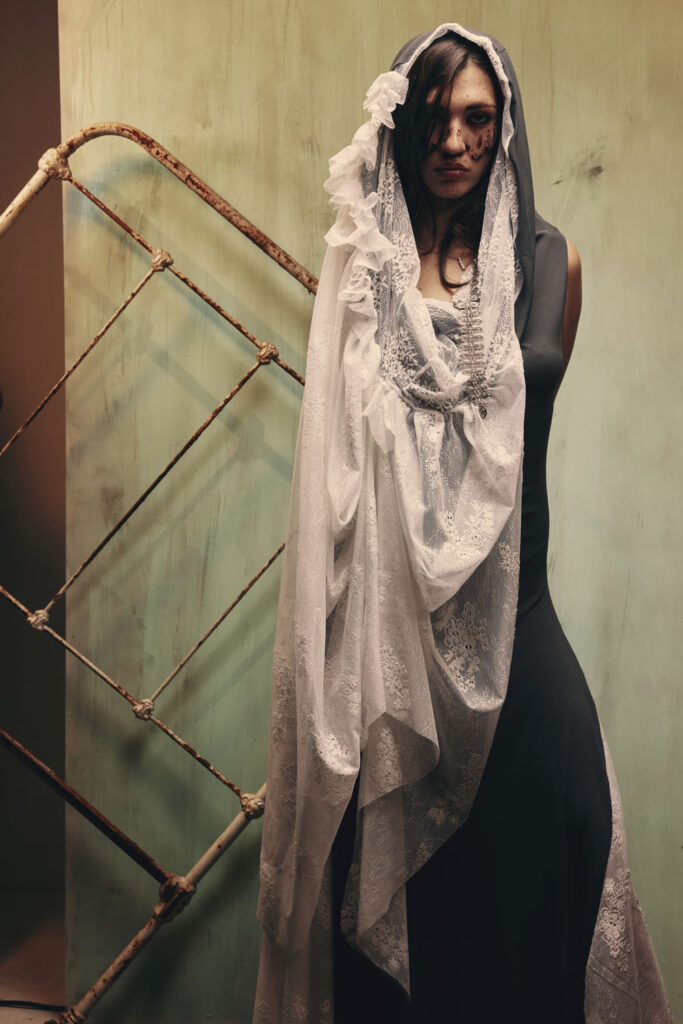

For her, graffiti represents one of the most immediate forms of protest. It gives ordinary people a way to claim public space and express ideas that might otherwise go unheard. As political tensions rise, the walls of Tbilisi become records of resistance.
“These markings are artifacts,” she says. “Imprinting them into my work feels like bringing the streets of Tbilisi to life and carrying them over into a new form.”
The garments function as more than fashion pieces. They preserve fragments of a city, a moment, and a movement. Each print carries the contributions of many people: the person who tagged the wall, the friend who photographed it, the communities that live around it, and the team that ultimately helped bring the collection to life.
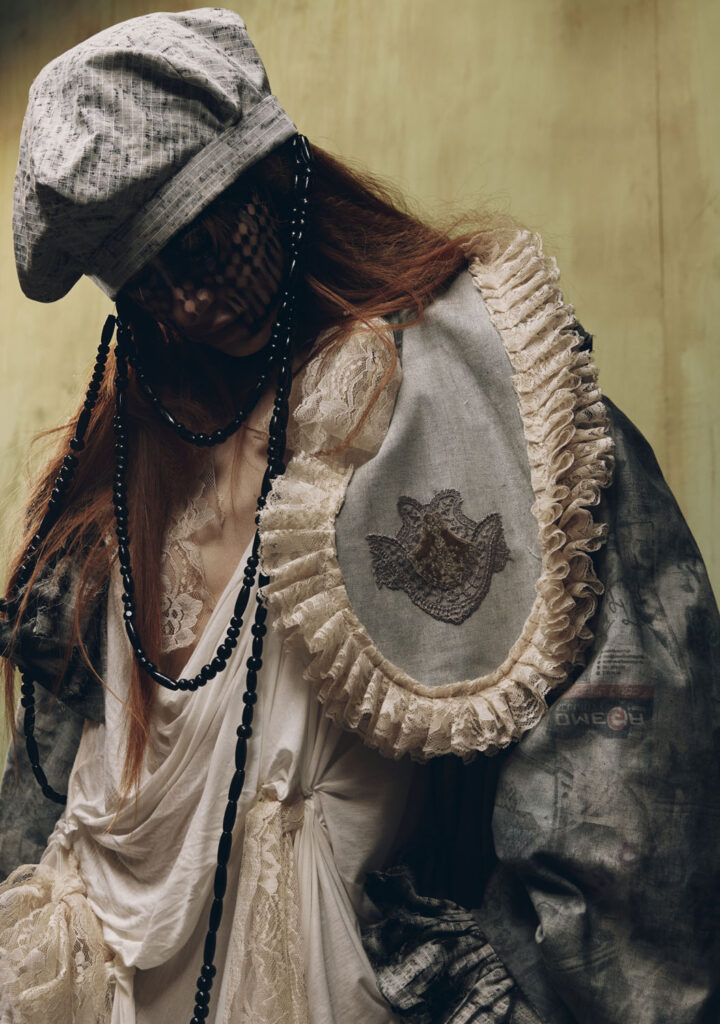
While the collection documents contemporary protest, it also draws strength from Georgia’s cultural history. Amiredjibi looked to The Knight in the Panther’s Skin, the iconic Georgian epic written by Shota Rustaveli, as well as the traditional attire of Kinto dancers. These references informed the silhouettes, materials, and styling throughout the collection.


A wool hat adorned with a pheasant feather references depictions of Rustaveli himself. Elsewhere, draped forms echo illustrations inspired by the epic. Historical references appear alongside contemporary imagery, creating a dialogue between past and present.
The inclusion of Kinto traditions carries particular significance. Kintouri dance occupies an important place in Georgia’s cultural history and forms part of the country’s queer artistic heritage. At a time when queer communities face growing political hostility, these references take on additional weight. They preserve histories that deserve visibility and recognition.
For Amiredjibi, cultural preservation is never separate from politics.
“Coming from the country of Georgia, a 2,500-year-old nation whose territory has long been contested by larger foreign powers and subjected to cultural erasure, I see cultural preservation as a form of resistance.”

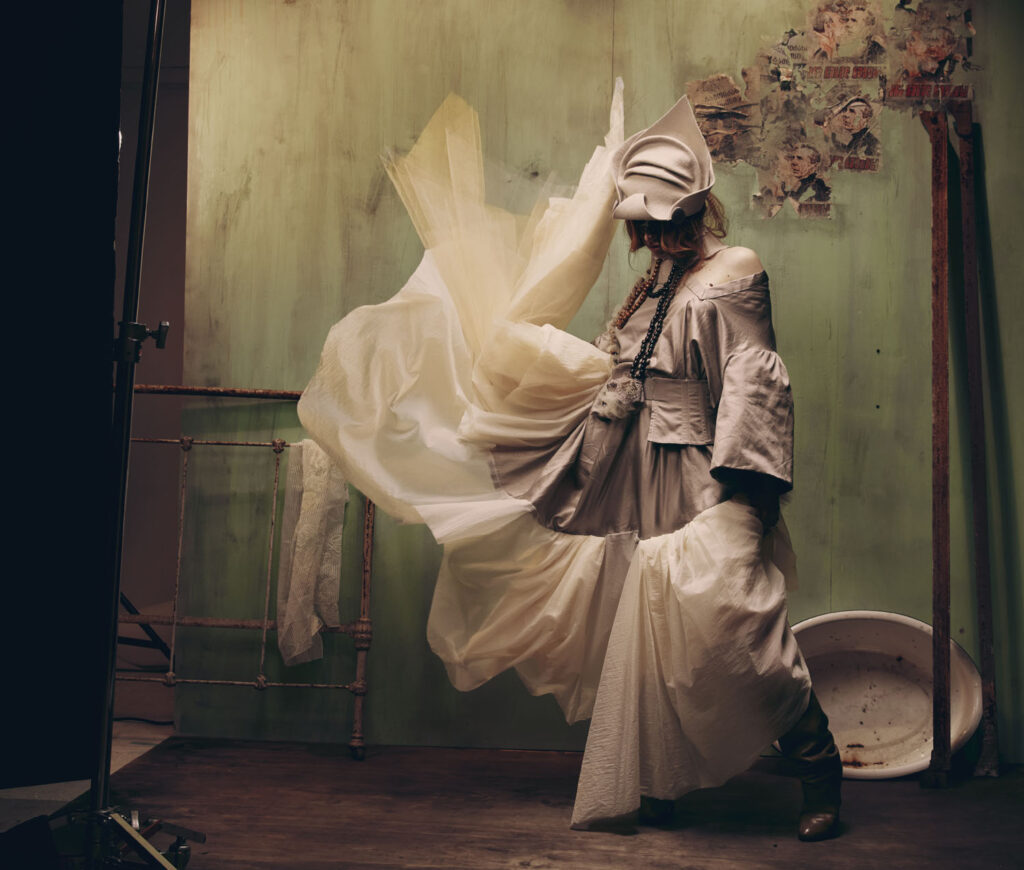
That idea reaches its most direct expression in Look 5, titled Pioneer Kobakhidze. The look uses satire to critique Georgia’s current political climate. Inspired by Prime Minister Irakli Kobakhidze and what many young Georgians view as the country’s democratic regression, the design combines references to Soviet school uniforms and the Soviet Pioneer youth organization.
Red accents recall the scarves worn by Pioneer members, while an exaggerated headpiece references Kobakhidze’s famously unkempt hairstyle. The result feels humorous at first glance, but the underlying message remains serious. Through satire, Amiredjibi highlights concerns about authoritarianism, historical repetition, and Georgia’s relationship with its Soviet past.

Despite these political themes, Fight or Flight remains deeply human. At its heart lies a question that extends far beyond Georgia. What happens when the place you love begins to change in ways you cannot control?
The collection’s title captures that tension. Many young Georgians face difficult choices about their future. Some stay and fight for change. Others leave in search of opportunities unavailable at home. Amiredjibi understands both impulses.
“In many ways, I am trying to do both at once,” she says.
She dreams of returning home, yet she also values the opportunity to represent Georgia internationally. Like many members of the diaspora, she lives within that contradiction. Distance creates longing, but it also creates a platform.
Ultimately, Fight or Flight refuses to separate politics from culture or personal memory from collective history. Instead, it treats them as interconnected forces that shape everyday life. Every garment, print, and reference contributes to a larger story about identity, survival, and belonging.
For audiences unfamiliar with Georgia, Amiredjibi hopes the collection sparks curiosity about the country’s culture and history. More importantly, she hopes people recognize something universal within it: the desire to protect what matters before it disappears.
In Fight or Flight, fashion becomes a living archive. It preserves stories, traditions, friendships, and acts of resistance that might otherwise fade from view. Through that process, Amiredjibi demonstrates that preservation itself can become a powerful form of protest. Sometimes resistance appears on a city wall. Sometimes it survives through generations of cultural memory. And sometimes, it takes the form of a garment.