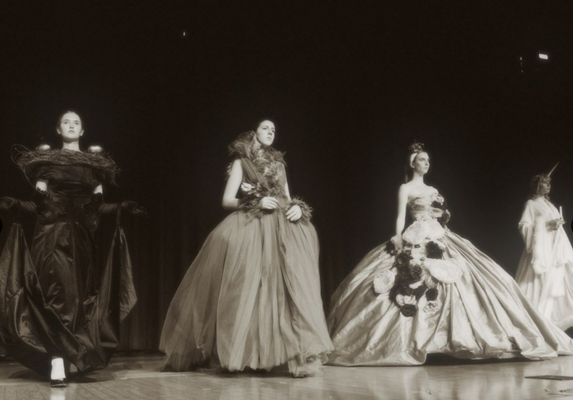


Fashion often looks forward. However, for Aditi Srivastava, it became a way to revisit the past. Her thesis collection, created at the Fashion Institute of Technology in New York, bridges traditional Indian craftsmanship with British imperial silhouettes. In doing so, it tells a powerful story about survival, identity, and historical resistance.

“I found it increasingly difficult to engage with fashion stripped of its politics,” Aditi explains. As she observed the global fashion industry, she became aware of a troubling trend. Designers were frequently borrowing from Indian textiles and aesthetics without crediting their origins. Consequently, Aditi decided to push back, using her own work to restore context, meaning, and agency.
Much of her inspiration came from home. “Both my grandmothers lived through colonial India,” she says. “I grew up hearing stories about a turbulent time marked by great strife.” As a result, her designs are rooted not just in fabric but in lived experience. By drawing from generational memory, she transforms fashion into an act of cultural remembrance.
One of the most compelling looks in her capsule features a corset made from hand-dyed, upcycled Banarasi silk. The choice of textile was intentional. “Manipulating Banarasi silk into an English corset with raw, shredded boning channels carries my thesis metaphorically,” she says. The soft, ornate silk clashes with the rigid corset structure, representing the imposition of foreign control over indigenous tradition.
Moreover, Aditi paired the corset with a Tudor-style gabled hood. Constructed from safety pins, oxidized black metal jewelry, and wire, the hood is both delicate and unsettling. Pearls and lace mourning veils further enhance its historical symbolism. According to Aditi, figures like Catherine of Aragon and Anne Boleyn, despite their privilege, became symbols of lost agency. Therefore, the hood becomes a powerful emblem of constrained identity, both colonial and feminine.


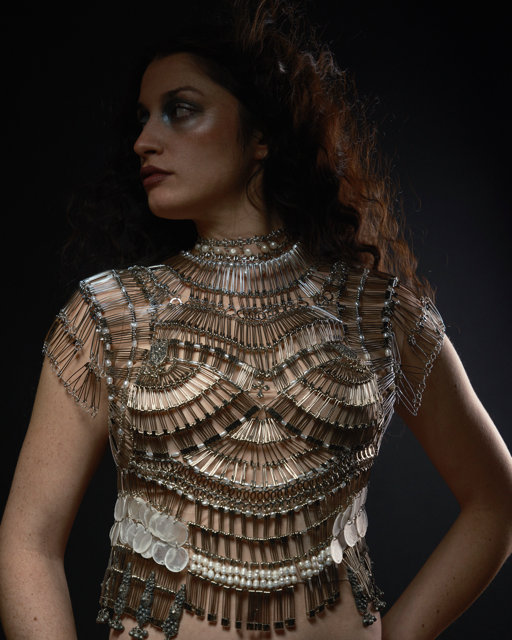
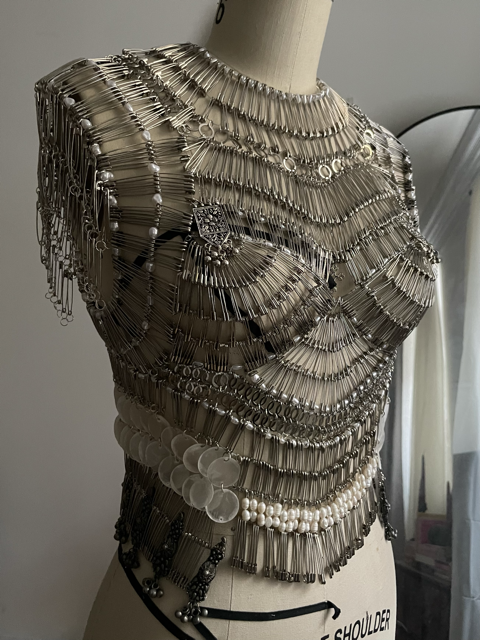
Meanwhile, her second look focuses on the safety pin, a seemingly mundane object that holds immense cultural and political weight. “A lot of saree draping is held in place with a humble safety pin,” she notes. Inspired by this detail, Aditi crafted a hand-linked safety pin top, echoing chainmail. This piece references both traditional Indian jewelry and the rebellious spirit of punk. “I loved using safety pins to represent rebellion and chaos,” she adds, connecting global subcultures with South Asian resistance.
Additionally, the top is adorned with pearls, mirror shells, and washers. These materials were sourced from New York, Hyderabad, and Italy, reflecting the diasporic nature of Aditi’s life. “As a love letter to my hometown of Hyderabad, pearls make several appearances,” she says. She also created a silver chrome-plated clutch from Atlantic clam shells, reinforcing her love of organic, historically resonant materials.
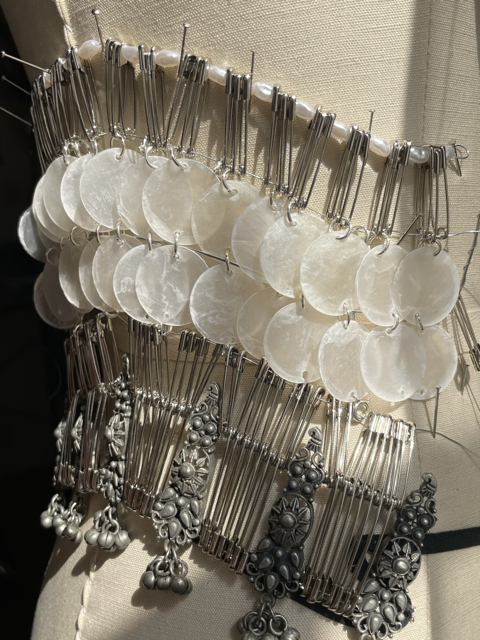
Throughout her process, craftsmanship remained essential. “Handcrafted and detailed construction was key to my technical approach,” she explains. In contrast to fast fashion, which often feels disposable, Aditi believes that garments should carry weight, both emotional and cultural. “In an era where trends fade before they resonate, the care of craft and quality feels more important than ever.”
Furthermore, her design approach is deeply intuitive. Years of training in patternmaking and draping helped her develop a method rooted in tactile exploration. “I enjoy designing physically, letting the material speak and seeing what it wants to do,” she says. This sensitivity to fabric gives her work a dynamic, almost sculptural quality.
Beyond technique, the project holds deep personal meaning. “This has been the most personal storytelling of all my work,” she reflects. “It was extremely important to me that I translated my heritage with integrity.” Through this capsule, Aditi challenges how South Asian fashion is often viewed, boxed into narrow categories or reduced to surface-level aesthetics. “I aim to subvert that expectation,” she adds.
While her aesthetic draws from tradition, it also embraces darkness and drama. “This collection helped me settle into my identity, combining elements of my South Asian heritage with the haunting quality of the gothic,” she explains. Looking ahead, she hopes to explore new stories. “I’ve always been a little obsessed with the Salem and New Brunswick Witch Trials. I would love to start there for my next collection.”
Her time at FIT played a crucial role in shaping this creative evolution. “I came to FIT with a strong background in illustration,” she recalls. “But I discovered a deep passion for draping and construction.” Surrounded by talented peers and supportive faculty, she gained the tools and freedom to take creative risks. As a result, she now works with greater confidence and clarity of vision.
In Threads of Resistance, Aditi Srivastava doesn’t just design garments. She constructs narratives, weaving together threads of memory, history, and identity. Her collection transforms textiles, metal, and symbols into powerful tools for reflection and reclamation. Each look challenges silence, honors resilience, and reclaims space, both in fashion and in history.