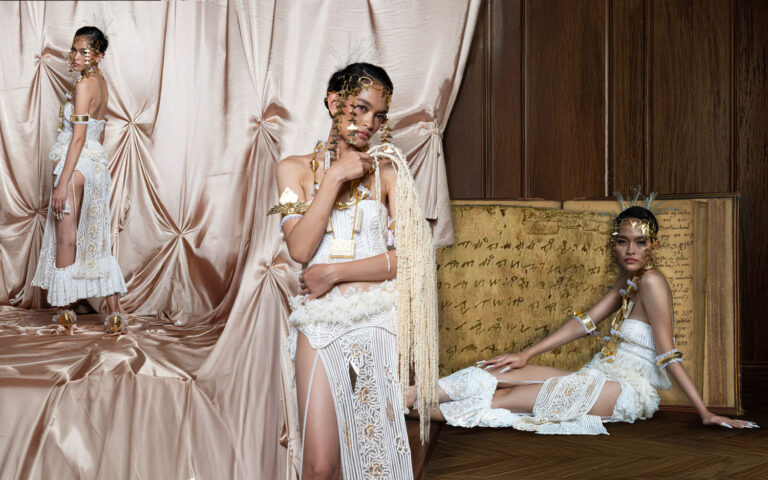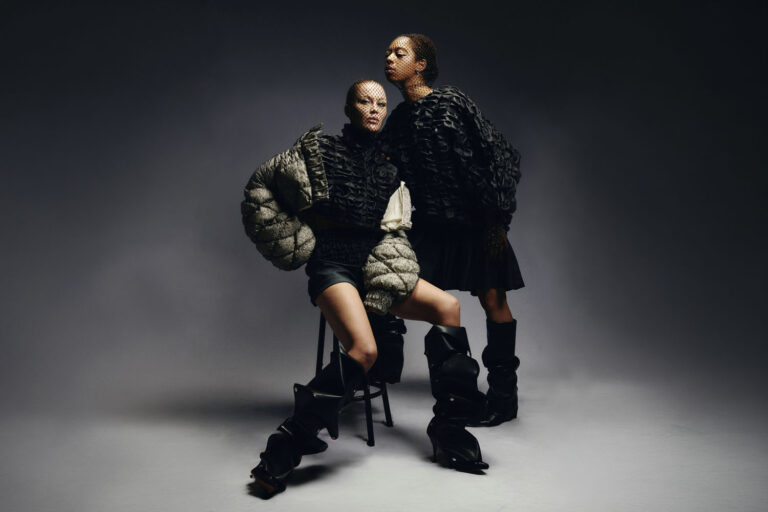


Founded by London-based designer Jojo Zan, The Digital Amber explores what it means to leave traces in a world increasingly defined by data. Through 3D-printed, bio-based accessories that mimic erosion, fossilisation, and decay, the label imagines future relics of digital identity that are quiet, reflective objects that sit between technology and archaeology, memory and material.
“I kept thinking about what remains after humanity,” Jojo Zan says, and the sentence lands like a small, deliberate claim. It is not a theatrical provocation; it is the tidy, strange seed of an idea that has quietly shaped everything she makes. Jojo Zan is the founder and creative director of The Digital Amber, a London label that dresses the idea of memory itself with 3D-printed, bio-resin objects that look like things the future might dig up and try to understand.
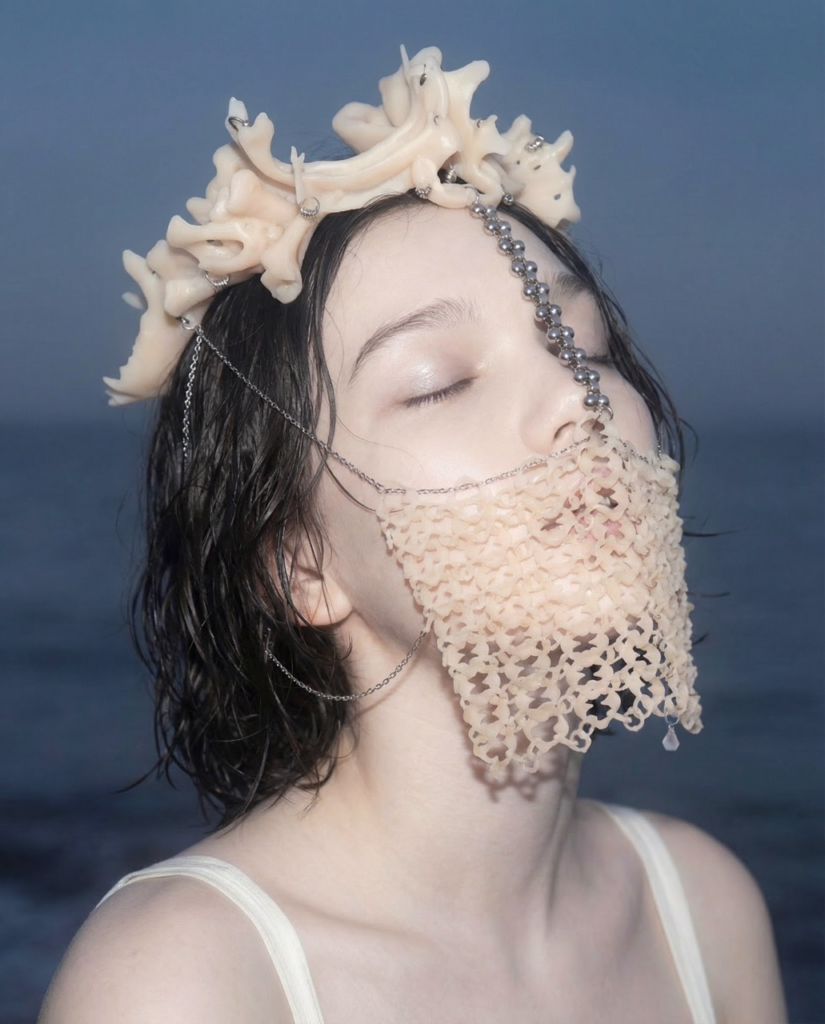
The images of The Digital Amber are not ostentatious. They are patient: crown-like headpieces that nod at armour and fossil, belts and chains that hang like artifacts offered in a museum display. There is a soft insistence to them, the suggestion that these objects are not only adornment but testimony. “Amber represents an ancient and enduring vessel of preservation,” Jojo explains. “I imagine future humans discovering new ways to carry virtual consciousness. That vessel could function like amber does today.”
Jojo’s vocabulary is animated by archaeology. She thinks in sediment and erosion, in the way things accumulate and are forgotten. “In the digital realm, everyone is akin to a piece of amber,” she says. “Each person preserves layers like data, memories, identities. My question was: can we make those invisible imprints visible?”

The answer she offers is not literal. It is speculative and tactile: objects that look as if time has already acted on them. Algorithmically generated patterns simulate corrosion and crystallisation; 3D printing translates those patterns into material that can be touched, weighed and worn. The effect is uncanny. Something born from code looks older than a lot of manufactured things we call vintage.
There is a moral intelligence in that choice. Jojo refuses polish for the sake of polish. Her surfaces are intentionally imperfect; her materials being PHA and bio-resins. In this, the work makes a quiet political point about the way technology promises permanence while producing ephemera. The Digital Amber asks the opposite: what if we made objects that accepted change?
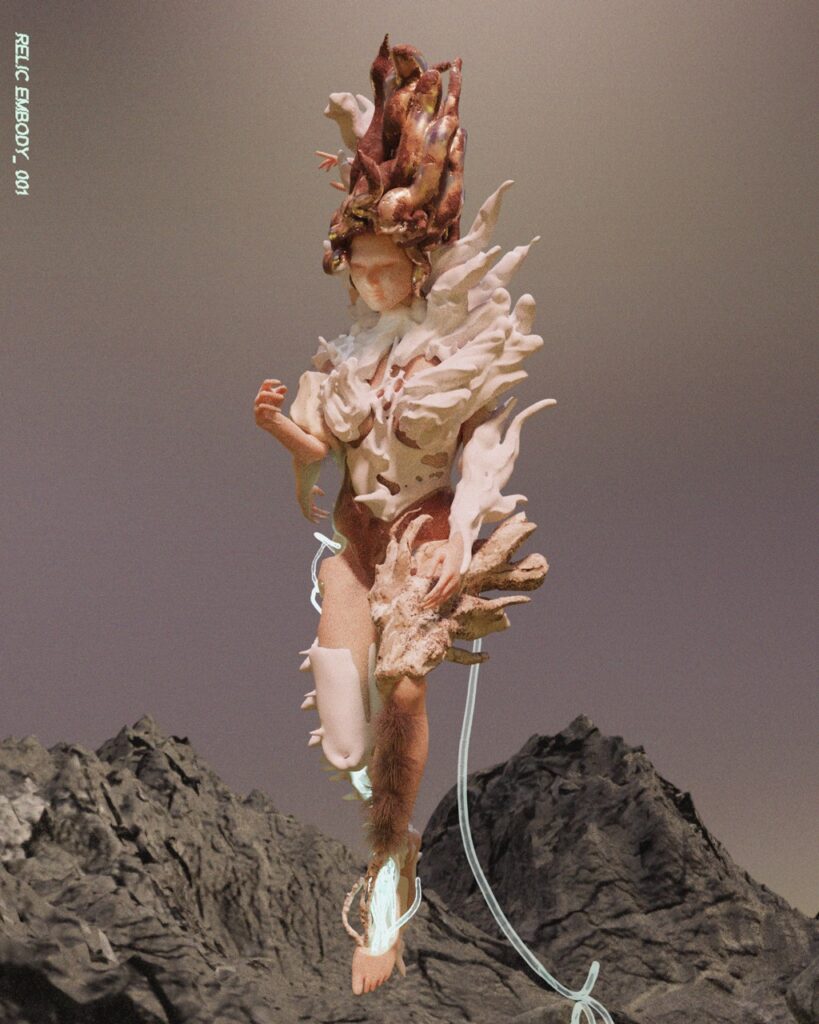
Jojo’s route to jewellery and garment-making passes through VR studios. She worked with Gravity Sketch and learned to think three-dimensionally in a space where gravity and material limitations don’t apply. “Designing in virtual environments allowed me to imagine forms that I could later test against the body,” she says.
It is a useful paradox: virtual space frees you from the body, but the body becomes the final arbiter. When a printed structure meets fabric, it must negotiate movement, weight, skin. That negotiation between impossible forms and lived experience creates tension that animates the work. The headpieces, for example, are not costumes. They are objects that ask something of the wearer: a posture, a slowness, a reconsideration of how jewellery can function as memory rather than mere glamour.
Discussing the Eroded Crown Headpiece Jojo becomes almost conversational in the way she returns to it. “It’s a piece I’m deeply attached to,” she says. It marks a turning point: from accessory experiments to a more confident, structural language. The crown is built like a small ruin, bone and fossil forms interlaced with chainmail textures that read as both protection and relic.
The crown’s strength is its humility. It suggests ceremony without spectacle. It seems to have survived something. That sensation of an object that has already lived reappears across the collection. There’s a layered melancholy in that: an admission that memory and identity are not tidy narratives but palimpsests.
On sustainability, she does not offer slogans. She offers practice. “Technology can increase efficiency, but it also generates waste,” she says. “I work with biodegradable materials because their instability is conceptually aligned with what I’m exploring.”
That is an important distinction. In place of easy green language, Jojo Zan embraces material limits. She uses the tendency of bio-resins to change as a design feature, not a problem to be solved. The effect is humane: the work acknowledges labour, dust and decay. The things often erased by clean-screen aesthetics. The pieces are not defensive against time; they are honest about it.

That honest treatment is what sets The Digital Amber apart from projects that use sustainability as ornament. Jojo’s approach is less about claiming an ethical badge than about folding the ethics into the logic of design itself.
The most recent shoot took place on a coastline, and there is a clear reason why the sea makes sense for this work. Wind and sand are agents of the same processes, Jojo is trying to visualise erosion, sedimentation, weathering. “I wanted the pieces to feel exposed to nature rather than controlled,” she explains. A headpiece tussled by gusts looks less like a prop and more like a found object incubated by tide and wind. There’s an honesty to shooting in these conditions: the elements become a co-designer.
Jojo has presented the work in London and Beijing. The response, she says, was valuable for what it revealed: certain questions about identity, about what persists are not local curiosities. They circulate. “Presenting in different cultural contexts allowed me to see how the ideas resonate across audiences,” she says.
The resonance suggests something important: while the materials and technologies may be new, the core concerns like memory, loss, what we value enough to preserve are shared. That is likely why the work feels familiar and strange at once: it borrows the language of both science fiction and archaeology, and places a human centre in between.
“I hope people slow down,” Jojo says. “I want the work to feel personal rather than overwhelming. Ideally it invites reflection on time, memory, and how our present choices shape what will remain in the future.”
There is no moralising here. The invitation is modest and urgent at once: to take stock of what we preserve and why. In a fashion ecology dominated by velocity, newness, micro-trends, seasonal discard, The Digital Amber asks something simple and difficult: could design cultivate patience?
Jojo Zan finishes where she began: with curiosity rather than certainty. “I’m interested in change itself,” she says. “Rather than aiming for a fixed direction, I’m excited by uncertainty.”
That humility, an embrace of uncertainty feels like an ethical stance. The Digital Amber is not a futurism of triumph; it is a practice of listening. The objects are modestly speculative: imagining futures where memory is materially legible, where the debris of our digital lives becomes a kind of archaeology. And in that imagining, there is room for reflection.
If fashion is usually a language of immediate desire, The Digital Amber speaks in a different tense, past and future at once. It asks us to consider what we are making now that might matter later.