
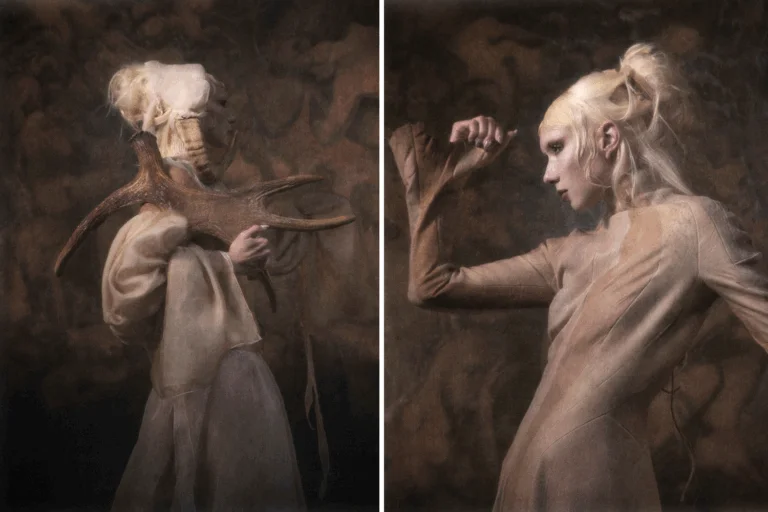
When Sunniva Olavsdatter began developing her debut collection, HYKLER — Ulv i Fåreklær (Wolf in Sheep’s Clothing), she wasn’t simply exploring silhouettes or textiles. She was asking a harder question: what does it mean to wear another body, and why are we so quick to disguise the true costs of fashion?
“The metaphor of a ‘wolf in sheep’s clothing’ grew out of my disappointment with the way humanity relates to nature,” Olavsdatter explains. “We live in a world where taboos still prevent people from wearing their grandmother’s old fur coat, yet it feels acceptable to buy a brand-new ‘faux fur’ from a fast-fashion chain, carrying its own carbon footprint, human suffering, and the microplastics that poison what’s left of our ecosystems.”


For Olavsdatter, the wolf is not a symbol of outside threat. It is us. “Humans are, in fact, the real wolf: the species that takes another creature’s skin and wears it,” she says. With that recognition, her collection turned into a meditation on disguise, predation, and denial. It insists fashion is not an innocent pleasure but a mirror of human arrogance.
She describes her garments as “second skins,” never flat against the body but alive with tension between human and animal. Draping became her main method, mapping the parallels between hides and the human form. “A body is never a flat canvas; like how a map can never truly represent the globe, pattern cutting can never perfectly represent skin,” she explains.
Her material choices underline this critique. She worked with discarded skins, wool, and silk, fabrics that carry history, but often provoke unease in Western culture. At the same time, petroleum-based alternatives are marketed as ethical and flood the market. “Wearing an antique fur coat is a sin, but buying new polyester is virtue,” she says. “Through my process, I wanted to mock that hypocrisy, to show how clothing has always been about stolen bodies, whether animal or petroleum. By reworking discarded skins and textiles, I’m not only exposing these double standards, I’m also suggesting that honesty and longevity might be the most radical forms of sustainability we have left.”


Designing HYKLER became a fight between instinct and intention. Instinct appeared when she let materials drape freely. Intention arrived when she imposed strict seams and structures. “That struggle shaped every decision,” she reflects. “It became less about reaching a polished result and more about staging the conflict itself: raw, instinctive pieces against over-controlled ones.”
One moment stands out. She found an antique cowhide carpet, heavy and resistant to change. “It had a presence that refused to be cut apart or reshaped, as if it carried the soul of the animal still inside it,” she recalls. She cut only a single opening for the head and wore it as a poncho. “I understood that the material wasn’t mine to control, that instead it demanded my submission. From there on the work became less about design and more about ritual.”
This surrender complicates the very idea of control in fashion. It reframes design as dialogue with materials rather than domination. What emerges is not a polished garment but a confrontation. It reminds us that our mastery over nature is, at best, an illusion.


That same confrontation shaped how she chose to present the collection. She staged it inside Emanuel Vigeland’s Mausoleum in Oslo, a shrine filled with frescoes of birth, death, and desire. For her, the setting revealed fashion’s own vanity and decay. “The industry is already oversaturated with its own shrines, glossy stores, glass vitrines, endless archives, where garments are embalmed as luxury rather than lived in. And further down the line, they end up in mass graves: textile necropolises in places like Chile and Ghana,” she says. Placing the garments in an actual tomb extended this cycle to its most literal conclusion. “Inside the Mausoleum, the garments stopped performing as fashion; they appeared instead as offerings to our own vanity.”
The result is unsettling, and deliberately so. HYKLER strips fashion of its glamour, exposing it as both disguise and confession. Each piece reminds us that behind sustainability campaigns and glossy marketing lies a history of exploitation, of bodies, ecosystems, and futures.
Olavsdatter’s collection does not offer solutions. Instead, it makes contradictions visible. Clothing is the perfect medium for this because it is both intimate and performative. It touches our skin while also shaping how we are seen.
HYKLER insists that fashion cannot be innocent. It is always a matter of stolen bodies, whether animal, human, or petrochemical. And by staging this uncomfortable truth with drama, ritual, and raw honesty, Sunniva Olavsdatter forces us to recognize what we prefer to deny. The wolf in sheep’s clothing, it turns out, is not out there. It is already here, wrapped around us, hidden in plain sight.
Credits
Art Direction: Sunniva Olavsdatter, Bertine Monsen
Photography and retouch: Bertine Monsen
Lighting Technician: Cameron Daravi
Lighting assistant: Tommy Haugen
Make-up: Theo Mekonnen Myking
Hair: Runa Sol Indiana Hveding
Talent: Christel, Lian Biglari, Vera Wollmann
Shoe Curator: Yosan Tewelde
Styling: Yosan Tewelde, Vera Wollmann, Sunniva Olavsdatter
Hair assistant: Susanne Lauritsen
Assistants: Paal Hetland Sande, Aurora Aven
Creative Consultant: Vera Wollmann
Tattoos on leather garments: Cora Emily Parker
Videography: Bror Oscar Bjørneseth
Talent: Christel, Lian Biglari, Vera Wollmann
Location: Emmanuel Vigelands Mausoleum


